Overview
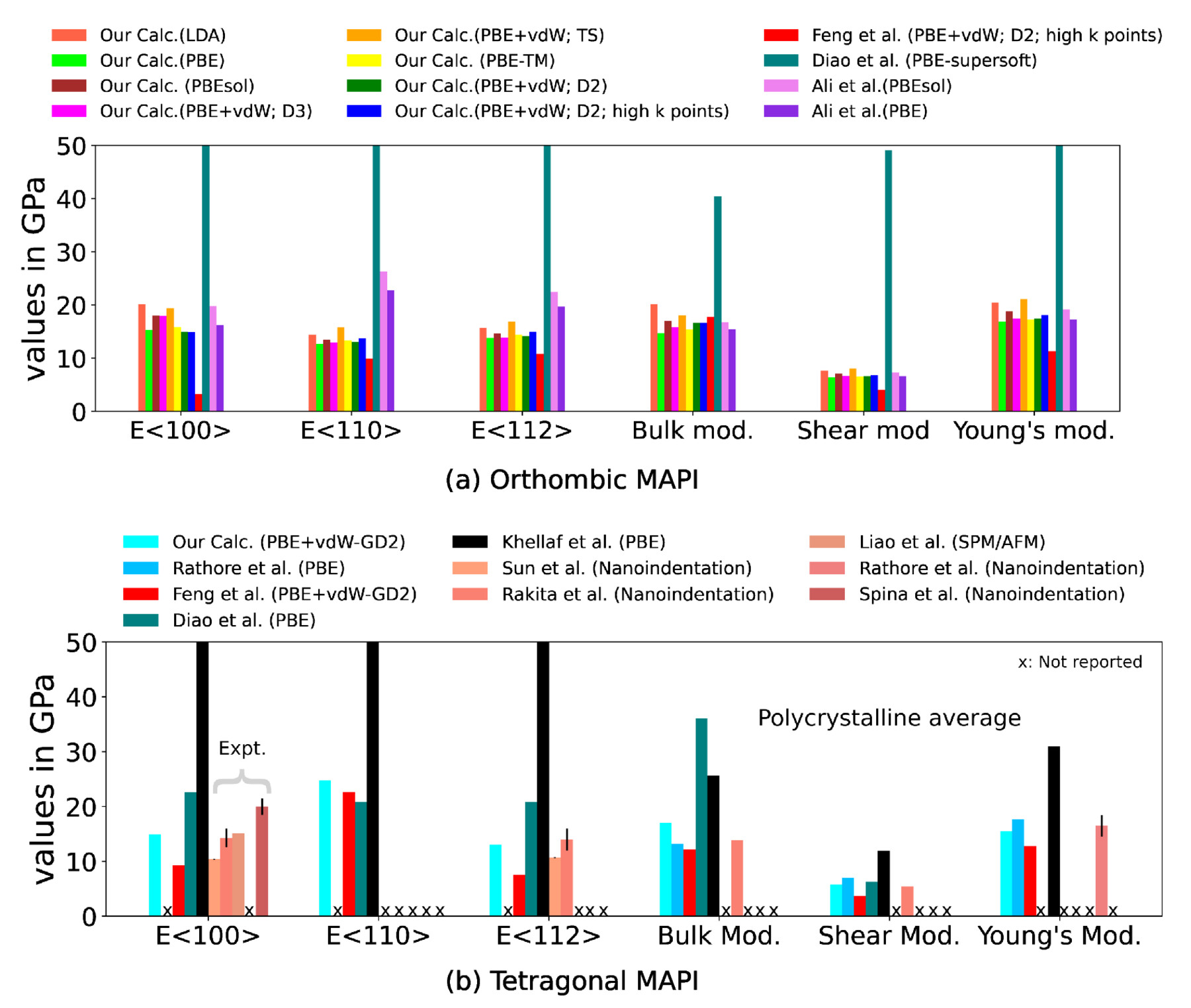
This work systematically evaluates the mechanical properties of cubic, tetragonal, and orthorhombic CH₃NH₃PbI₃. By testing structures, functionals, van der Waals corrections, pseudopotentials, k-point sampling, calculation methods, symmetry assumptions, and averaging formulas, it identifies the main sources of disagreement in the literature.
Key resultCrystal symmetry and exchange-correlation treatment dominate the discrepancies; PBE with Grimme-D2 gives the best overall agreement.
My contributionSystematic first-principles benchmarking, elastic-tensor analysis, and comparison with experiment.
Research question
Why do published calculations and measurements of MAPI’s elastic properties disagree, and which computational choices produce reliable reference values?
Approach
- Complete stiffness and compliance tensors for all three MAPI phases
- Comparison of energy-density and stress-based elastic calculations
- Tests of LDA, PBE, PBEsol, pseudopotentials, and van der Waals schemes
- Tensor rotation, anisotropic Young’s modulus, and Voigt–Reuss–Hill polycrystalline averages
What emerged
- Energy-density and stress methods, as well as the tested pseudopotentials, produce relatively small differences.
- Correct treatment of crystal symmetry and the anisotropic stiffness tensor is essential; inappropriate symmetry assumptions can substantially distort results.
- Exchange-correlation functionals strongly affect structure and therefore elastic response, while van der Waals corrections are important for tetragonal and orthorhombic phases.
- PBE with Grimme-D2 and dense k-point sampling gives the best agreement with available measurements; dense sampling matters most for directional anisotropy rather than polycrystalline averages.
Explain the work
Media and supporting material
This area is ready for a short video, selected presentation slides, figures, datasets, or an interactive explanation as the project page develops.
Project media
Video · slides · figures